Students Help Lay Groundwork for Environmental Restoration Project
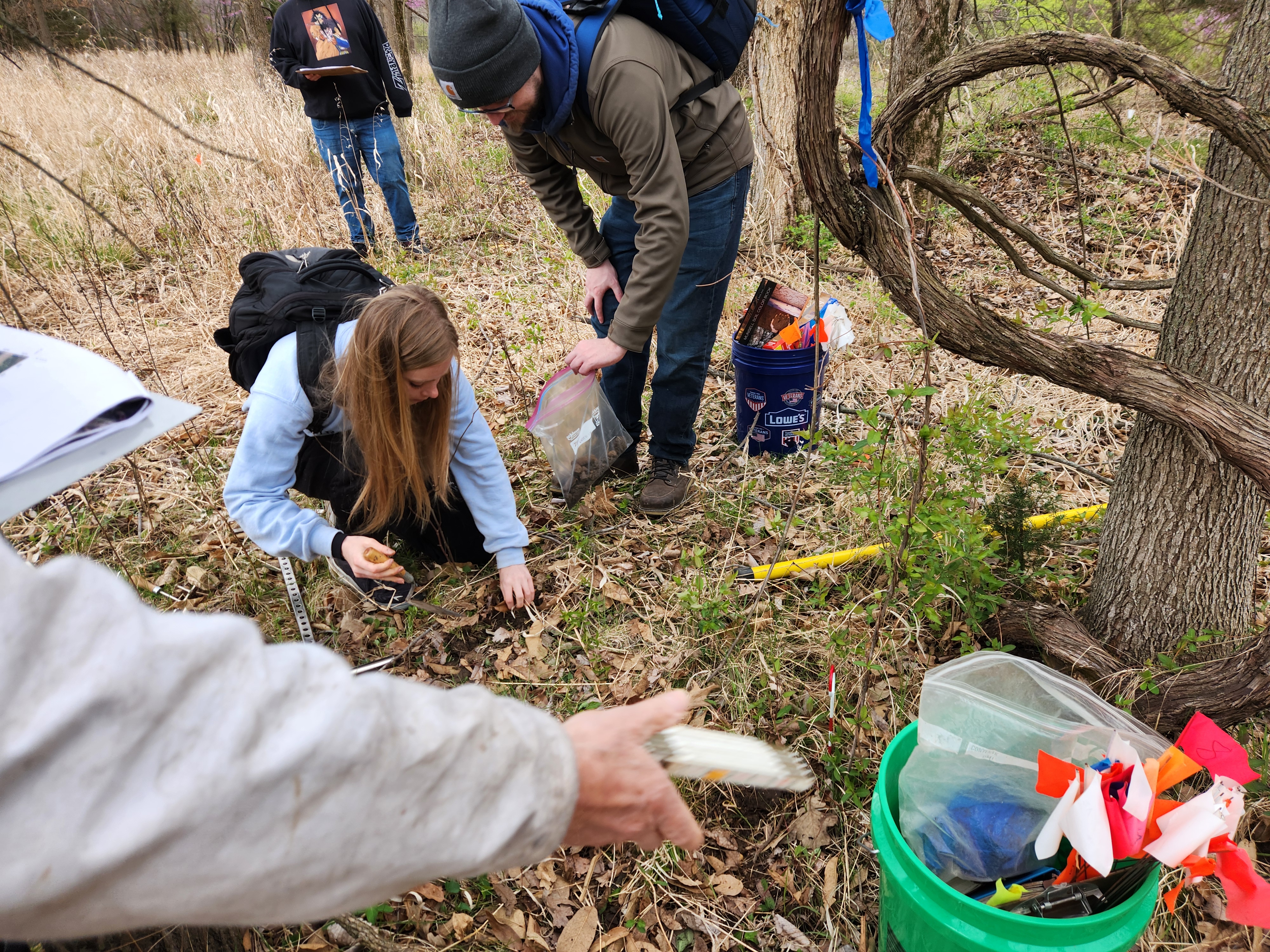
Students in the Field Ecology course at the KU Edwards Campus (KUEC) went beyond the classroom last spring – literally and figuratively – to benefit a significant area environmental project.
Field Ecology is an upper-level course in Environmental Studies, a JCERT-supported degree program that focuses on research methods, data analysis and interpretation. This class had the opportunity to put those skills into practice with Renewing the Blue, a major, multi-year environmental project. Its goal is to revitalize up to 250 acres of riparian habitat along the Blue River.
The river extends over 40 miles, beginning just downstream of the Overland Park Arboretum in Johnson County and flowing to the Missouri River in Kansas City, Mo. The riverbanks are in critical need of restoration to protect water supplies and green spaces for adjacent neighborhoods and ecosystems. The restoration kicked off this fall.
Funded with $5 million from the American Rescue Plan Act and awarded by the Missouri Department of Natural Resources to the City of Kansas City, Mo., it is a collaborative effort involving four regional environmental nonprofit organizations: Bridging the Gap, Deep Roots KC, Heartland Conservation Alliance and the Mid-America Regional Council.
KU Edwards Students Get Their Hands Dirty
KUEC students helped lay the groundwork for the project by developing baseline soil and vegetation collection methods and data.
“We used a procedure developed by long-time KU faculty member Dr. Bob Hagen to create vegetation survey methods coupled with soil sampling. Protocol training, sample collection and testing were part of the Field Ecology course,” said Environmental Studies professor Scott Schulte. “We spent the spring semester collecting vegetation data and analyzing soil samples in our KU Edwards Campus Environmental Laboratory. Our students also assessed restoration progress by testing samples from the previously restored Municipal Farm site, a historic and environmental landmark in Kansas City, using it as a benchmark for what successful rehabilitation looks like.”
The impact of the course didn’t end when the semester did. Several students – including current senior Matthew Paulson and recent graduates Robb Morris and Katie Garey – were hired as summer interns by the Heartland Conservation Alliance.
Under the guidance of Schulte, Hagen and Environmental Assessment program director Terri Woodburn, the interns continued their research both in the field and at the KUEC lab.
For Paulson, the internship provided the opportunity to dive deeper into field research and environmental planning.
“The field activities combined sampling soil, inventorying woody/herbaceous species and studying stream health for comprehensive site surveys used to document baseline conditions,” he said. “These were critical for establishing operating practices for continued observation throughout the restoration and after to determine which practices work best.”

Paulson also worked in the lab to document and plan surveys, write site histories and analyze soil samples using carbon detection techniques.
For Morris, the internship was his first professional experience applying classroom knowledge to a real-world project.
“We would mark the soil and vegetation plots, note the color, texture and structure of the soil and measure the circumference of all the woody stems and vegetation,” Morris said.
Garey brought a unique perspective to the project. As a double major in Environmental Studies and Film and Media Studies, she found a way to combine both her passions. She created a film about The Municipal Farm that served as her capstone project for both degree programs.
“I use filmmaking as a tool to convey environmental stories and inspire awareness and action,” Garey said.
For the HCA internship, in addition to working alongside her peers, Garey filmed and documented the summer project to create training materials for the Renewing the Blue team and to raise public awareness about the restoration work.
Community Project Inspires Students
The Environmental Studies program at KU Edwards has deeply inspired and transformed these students. Garey plans to continue using storytelling through film to drive meaningful change. Morris, recognizing the positive effects of restored green spaces on community health and well-being, is committed to supporting urban environmental efforts.
Paulson is completing his senior year after shifting from a career as a tax accountant.
“Coming from a desk job, it was incredible to get outside and do work that truly makes a difference,” he said. His undergraduate research focuses on how vegetation and urbanization affect streambank erosion, and was invited to present his project at the Kansas Governor’s Water Conference in November 2025.
Paulson now works as a research assistant at the Kansas Geological Survey and credits his success to the KU Edwards faculty, the strong professional connections he’s made and his hands-on experience in the Environmental Studies program.
The work KU Edwards students did on the Renewing the Blue project demonstrates the power of hands-on learning. By getting out into the field and applying what they learned in class, they made real contributions to a major Kansas City-area environmental project, gained valuable experience, built lasting industry connections and discovered new directions for their careers.